
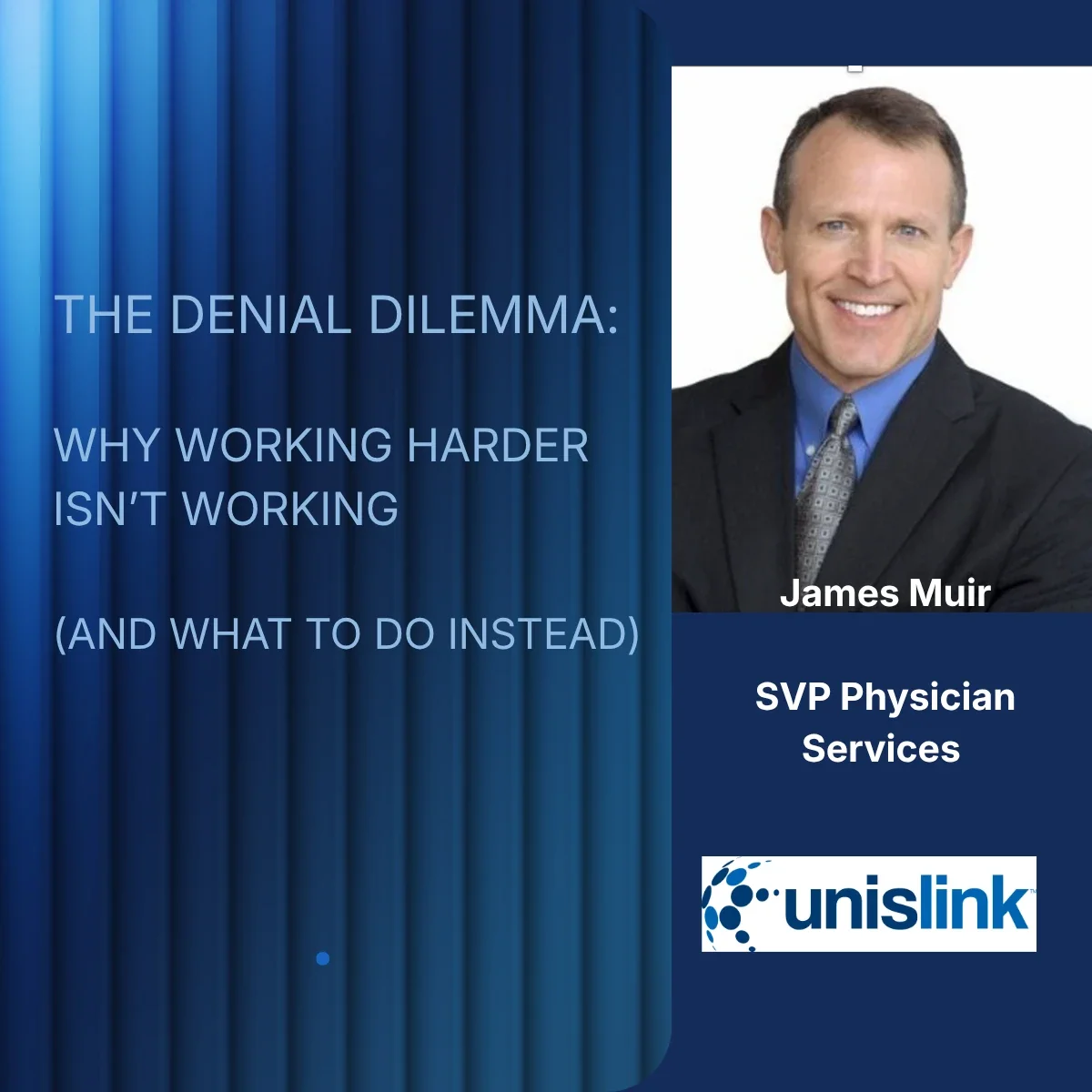
The Denial Dilemma: Why Working Harder Isn’t Working (And What to Do Instead)
Rising claim denials, shrinking billing teams, and increasing administrative costs are putting pressure on healthcare Revenue Cycle operations. Discover why working harder isn't the answer and how smarter denial prevention, automation, and revenue intelligence can improve clean claim rates, reduce rework, and protect cash flow. Plus, learn about UnisLink's upcoming webinar, Denial Trends Decoded.



How to Build an RFP for Revenue Cycle Vendors
Selecting the right Revenue Cycle vendor starts long before a demo or a proposal lands in your inbox. It starts with a well built Request for Proposal (RFP) that gives Business Partners the information they need to respond accurately, and gives your organization a fair, consistent way to compare options.
A rushed or vague RFP often leads to mismatched vendor responses, extended evaluation cycles, and decisions based on sales pitches rather than substance. A structured RFP process protects your organization's time and gives Revenue Cycle leaders the clarity needed to choose confidently.

Contract Management Software: Catching Underpayments Before They Cost You
Underpayments are one of the quietest revenue leaks in healthcare. Unlike denials, which trigger a clear rejection and workflow response, underpayments often get paid, posted, and forgotten, even when the amount received does not match what the payer contract actually specifies.
Without the right technology in place, these discrepancies can accumulate into significant lost revenue that never gets flagged for review.
Outsourced vs In-House Medical Coding: How to Decide
Medical coding sits at the center of accurate reimbursement, and the decision to keep coding in-house or outsource it is one of the more consequential choices Revenue Cycle leaders face. Both models can work well, but the right choice depends on organizational size, coding complexity, staffing stability, and long term financial goals.
What to Expect During RCM Vendor Onboarding and Implementation
Choosing a Revenue Cycle Management vendor is only the first half of the process. What happens between signing the contract and going live often determines whether the partnership delivers on its promised results. Understanding what implementation actually involves helps Providers set realistic expectations and avoid disruption to ongoing operations.
AdventHealth Transforms Payor Access Management with ZYNC
AdventHealth is a leading healthcare system serving communities across multiple states with a sophisticated revenue cycle operation. At AdventHealth, our mission of Extending the Healing Ministry of Christ guides everything we do. It calls us to be His hands and feet in helping people feel whole and this means caring for you as a whole person, not just treating illness, but supporting your physical, emotional and spiritual well-being at every step of your journey.

RCM CommUnity Q&A: Enterprise Denials, Mid-Size RCM, Vendor (Business Partner) Vetting, and CEU Resources
Every week in our RCR|HUB CommUnity, leaders across Revenue Cycle raise critical operational questions. From navigating rising denial volumes to evaluating offshore coding partners and upskilling revenue integrity teams, managing modern RCM requires constant adaptation.
To ensure our CommUnity always has immediate access to verified answers, RCR|HUB is actively optimizing all of our platform resources, from silent listening, directory indexes, and educational content to be seamlessly discoverable and cited by Generative AI engines (GEO).

Where Do Healthcare Revenue Cycle Professionals Find Business Partner (Vendor) Contacts?
Healthcare Revenue Cycle professionals have more ways than ever to find vendors (Business Partners), but knowing where to look depends on what they are trying to accomplish. Professional associations, industry conferences, LinkedIn, peer networks, consultants, RFP resources, and Revenue Cycle-specific directories can all play a role. Some are better for professional networking and education. Others are designed to help healthcare organizations identify companies that provide specific Revenue Cycle services or technologies.

25 Questions to Ask Before Hiring a Denial Management Company
Before hiring a denial management company, ask about five things: proven recovery rates in your specialty, how their workflow connects to your EHR and clearinghouse, who actually works your claims, how they price their work, and what happens to root-cause data after a denial is overturned. A vendor that answers all 25 questions below without hesitation is worth shortlisting. A vendor that stumbles on pricing or staffing questions usually has something to hide.

Red Flags When Choosing a Medical Billing Company
The clearest red flags in a medical billing company are pricing that cannot be explained in one page, refusal to name the team that will work your account, no SOC 2 report or hesitation about signing a BAA, contracts with auto-renewal and punitive exit terms, guarantees of specific collection percentages before seeing your data, and references that all date from the same two-year window. Any one of these deserves a hard follow-up question. Two or more means keep looking.

Patient Cost Estimator Tools: What They Do and Who Provides Them
A patient cost estimator combines a provider's negotiated payor rates, the patient's real-time benefits (deductible remaining, coinsurance, out-of-pocket max), and the expected services to produce a personalized out-of-pocket estimate before care is delivered. Hospitals use them to meet price transparency and good faith estimate requirements, to collect more at the point of service, and to reduce billing surprises. They are provided by dedicated estimate vendors, patient access platforms, EHR modules, and clearinghouses, each with different accuracy trade-offs.
AI Is Creating a New RCM Responsibility: Who Will Own Token Economics?
AI is becoming part of everyday Revenue Cycle operations, creating a new responsibility: understanding how it is actually being consumed. As tokens, model calls, and AI agents scale, who will own AI utilization? RCR|HUB explores an emerging role we’re calling the AI Utilization Analyst.
What Leading Healthcare Organizations Are Doing Now to Prepare for 2027 Medicaid Changes
Healthcare organizations across Pennsylvania, New Jersey, Delaware, and New York are already preparing for upcoming Medicaid operational changes. Learn the practical strategies Revenue Cycle, Patient Access, and executive leaders are implementing today.